Color Analysis: The Complete Guide to Finding Your Season
Color analysis is the practice of matching the colors you wear to your natural coloring — your skin's undertone, your hair, and your eyes. It assigns you a color season: a palette of shades that make your skin look clearer, your eyes brighter, and your face more rested. The wrong colors do the opposite.
Stylists have used seasonal color analysis for more than forty years. Carole Jackson's Color Me Beautiful (1980) put four seasons on millions of bookshelves, and Kathryn Kalisz's Sci\ART system (2000) split them into the twelve serious analysts use today. What changed recently is access: a professional in-person session runs $250 to $400 in the United States and needs a trained analyst with a case of drapes, while AI color analysis reads the same signals from a photo in about a minute.
This guide is for anyone deciding whether to get analyzed and how — including men, for whom it works identically. It covers how color analysis works, the 12 seasons and their best colors, what a professional session involves and costs, how AI does it from a photo, and what changes once you know your season. It does not cover makeup matching or hair color, and it is not a substitute for the analysis itself: reading about the seasons will not tell you yours.
Key takeaways
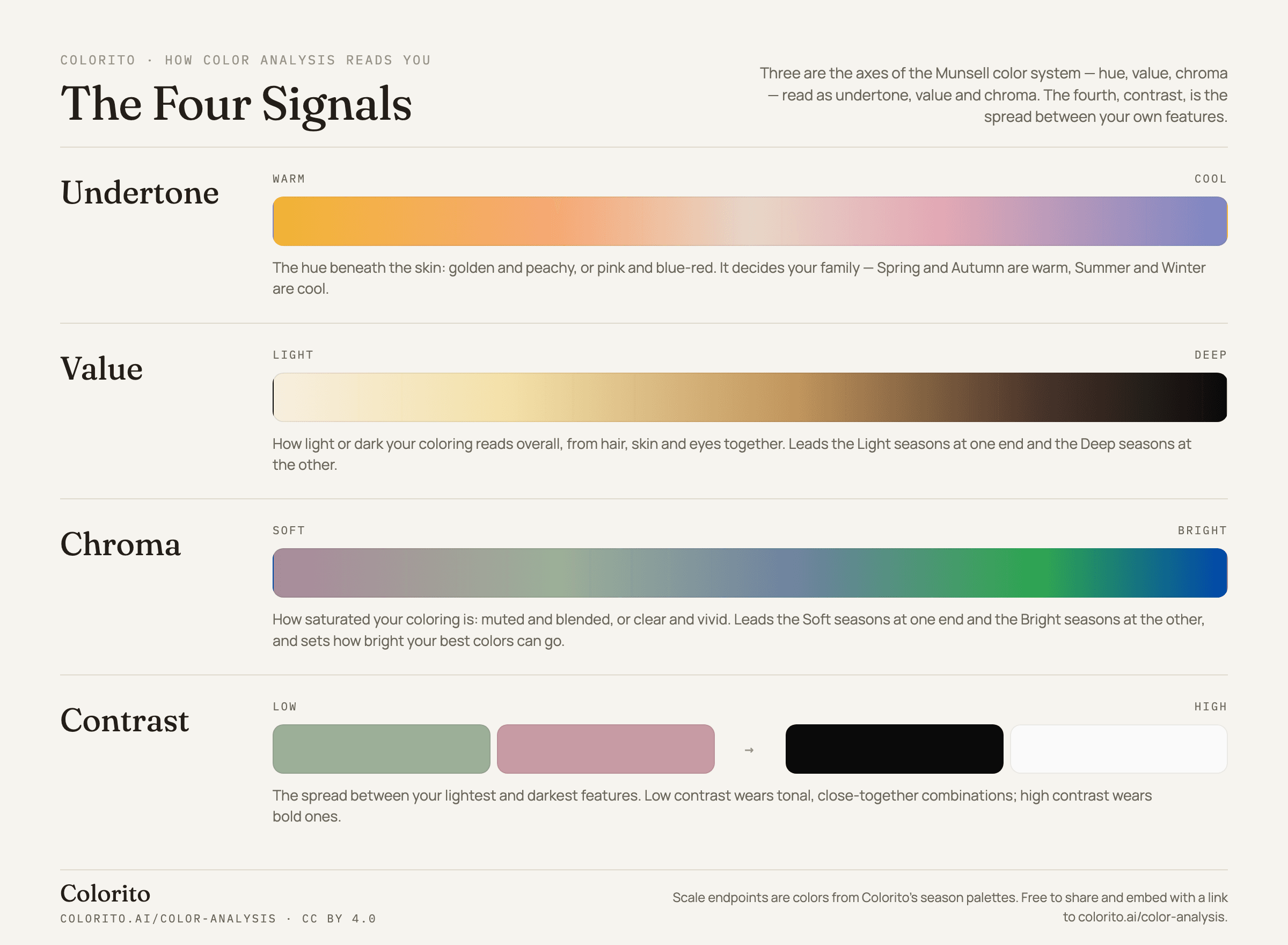
- —Color analysis reads four signals — undertone, value, chroma, and contrast — and matches them to one of twelve seasons, each with its own palette.
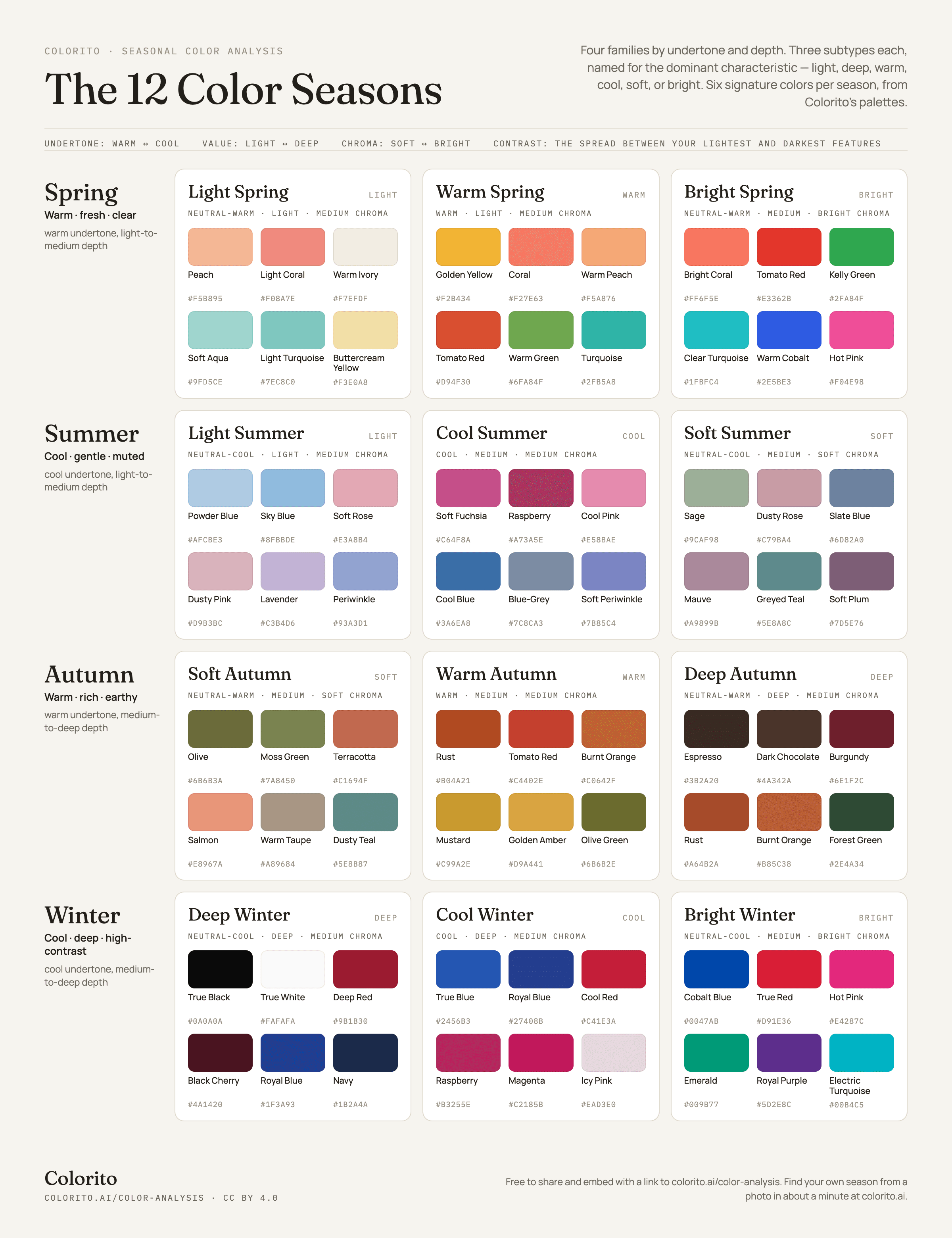
- —The 12-season system (Kalisz, 2000) refines Jackson's four seasons (1980) by adding a dominant characteristic: light, deep, warm, cool, soft, or bright.
- —A professional draping session takes 90 minutes to two hours. Across the 31 US studios in our index that publish a price, most standard sessions cost $250 to $400 and the median entry price is $250.
- —AI color analysis measures the same four signals from a photo. Colorito's takes about a minute, and a clean, unfiltered photo in daylight is what makes it accurate.
- —Your undertone never changes. A dramatic hair change can move you to a neighboring season, so retest after one.
Embed this chart
Free to share and embed under CC BY 4.0 with a visible link back to this page — the snippet below includes it. Please don't alter the values. Full terms.
HTML
<a href="https://colorito.ai/color-analysis"><img src="https://colorito.ai/twelve-seasons-map.png" alt="The 12 color seasons map: four families (spring, summer, autumn, winter) by undertone and depth, each split into three seasons by dominant characteristic, with six signature colors and their hex values per season" width="2400" height="3120" style="max-width:100%;height:auto"></a>
<p>Chart by <a href="https://colorito.ai/color-analysis">Colorito</a></p>What Is Color Analysis?
Every person's coloring can be read on four signals. Three of them are the axes of the Munsell color system, the century-old color-order model the 12-season method is built on: undertone (warm to cool — Munsell's hue), value (light to dark), and chroma (muted to bright). The fourth, contrast, is the spread between your lightest and darkest features.
Color analysis locates you on those scales, then hands you the palette of clothing colors that sit in the same territory. When your shirt shares your skin's undertone and matches your natural contrast, light reflects onto your face in a way that evens skin tone and sharpens your features. When it clashes, you look tired, sallow, or washed out — even in an expensive garment.
This is not a personality quiz and it is not about which colors you like. It is closer to measurement than taste. Your coloring is a fixed input. The palette is the output. That is why two analysts — or a well-built algorithm — should land on the same answer for the same face.
Embed this chart
Free to share and embed under CC BY 4.0 with a visible link back to this page — the snippet below includes it. Please don't alter the values. Full terms.
HTML
<a href="https://colorito.ai/color-analysis"><img src="https://colorito.ai/four-signals.png" alt="The four signals color analysis reads, as labeled scales: undertone from warm to cool, value from light to deep, chroma from soft to bright, and contrast from low to high, each with the seasons it leads" width="2400" height="1760" style="max-width:100%;height:auto"></a>
<p>Chart by <a href="https://colorito.ai/color-analysis">Colorito</a></p>
The 4-Season vs. 12-Season Color Analysis Systems
The four-season idea predates the book that made it famous: Suzanne Caygill was matching clients to seasonal palettes decades earlier, and Bernice Kentner published Color Me a Season in 1978 (Wikipedia: Color analysis).
Carole Jackson's Color Me Beautiful (1980) turned it into a mass-market system: warm and light was Spring, cool and light was Summer, warm and deep was Autumn, cool and deep was Winter. It was a good start and a blunt instrument. The many people with neutral undertones sat awkwardly between categories.
The 12-season system fixed that. Kathryn Kalisz, formerly one of four Master Munsell Colorists at Munsell Color Co., formalized the twelve-tone split in her Sci\ART system, launched in 2000 (Chrysalis Colour). It divides each family into three subtypes by your dominant characteristic — the quality most obvious about your coloring — which is what lets the system place the neutrals.
Twelve seasons is the standard serious analysts use today, and it is the system Colorito uses. It wins because it is specific enough to be useful: a four-season palette tells you to wear cool colors; a twelve-season palette tells you which cool colors, at what depth, and how saturated. Seasonal color analysis, explained walks through how the four families split.
The six dominant characteristics, and the two seasons each one leads:
- —Light — low value; hair, skin, and eyes all read light (Light Spring, Light Summer).
- —Deep — high value; dark hair and eyes dominate (Deep Autumn, Deep Winter).
- —Warm — undertone leads; golden or peachy skin (Warm Spring, Warm Autumn).
- —Cool — undertone leads; pink or blue-red skin (Cool Summer, Cool Winter).
- —Soft — low chroma; features blend rather than pop (Soft Summer, Soft Autumn).
- —Bright — high chroma; clear eyes and high contrast (Bright Spring, Bright Winter).
| Family | Subtypes | Overall quality | Best colors |
|---|---|---|---|
| Spring | Light, Warm, Bright | Warm, fresh, clear | Coral, golden yellow, turquoise |
| Summer | Light, Cool, Soft | Cool, gentle, muted | Powder blue, soft rose, lavender |
| Autumn | Soft, Warm, Deep | Warm, rich, earthy | Rust, olive, mustard |
| Winter | Deep, Cool, Bright | Cool, deep, high-contrast | True blue, cool red, emerald |
Professional Color Analysis: What a Session Involves and Costs
An in-person session with a trained analyst takes 90 minutes to two hours. You sit in natural or color-corrected light, bare-faced, hair covered. The analyst drapes dozens of colored fabrics under your chin in sequence — warm gold against cool silver, deep against light, muted against bright — and watches what each one does to your face.
Shadows deepen or lift. Skin evens out or goes blotchy. By the end, the drapes have narrowed you to one season, and you leave with a physical palette.
Expect to pay $250 to $400 in the United States for a standard in-person draping session. That band comes from Colorito's own index of 39 US studios: 31 publish a price, the median entry price is $250, most standard sessions fall between $250 and $400, and independents and group sessions start lower, from about $150 to $250.
House of Colour, the international franchise network, publishes no price list — each stylist sets their own rate, and the six House of Colour stylists in our index run from roughly $280 to $400 and up depending on the stylist and the day of the week. Premium packages reach $1,199. The full table, by studio and city, is on our color analysis cost page.
The draping method is excellent. The price and the waitlist are the barriers — which is exactly the gap AI closes.
| Option | Typical cost | Time |
|---|---|---|
| Independent analyst, in person | $250–$400 (from $175) | 90 min – 2 hrs |
| House of Colour stylist | $280–$400+, set per stylist | ~2 hrs |
| Premium studio package | $400–$1,199 | 2–3 hrs |
| Colorito AI color analysis | $9 | ~1 minute |
How AI Color Analysis Works From a Photo
AI color analysis measures the same four signals an analyst reads with drapes — directly from the pixels of your photo.
A drape session infers these values by watching your face react to fabric. An algorithm measures them from the skin, hair, and eye regions of the image, then maps the combination to one of the twelve seasons. The measurement is consistent: no dim salon lighting, no analyst having an off day.
The limitation is the input, not the math. Give it indirect daylight, no filter, and no heavy makeup and the result lands where a good analyst lands; give it a dim, filtered selfie and it will be wrong more often than a drape session in a good room. If you only want the first signal, the free undertone test reads it in a minute.
- —Undertone — whether your skin leans warm (golden, peachy) or cool (pink, blue-red), read from the cast of your skin across multiple regions of the face.
- —Value — how light or deep your overall coloring is, from your hair, skin, and eyes taken together.
- —Contrast — the spread between your lightest and darkest features. High contrast wears bold combinations; low contrast wears tonal ones.
- —Chroma — whether your coloring is clear and saturated or soft and muted, which decides how bright your best colors can go.
How the Read Is Made
These are the rules Colorito's analyst follows on every photo — the same checks a good human analyst runs before touching a drape:
- —The light is identified first — golden-hour sun, warm bulbs, neutral daylight, overcast, or flash. A golden cast that covers skin, hair, and the background alike is the light, not the person, and is discounted before anything else is read.
- —Undertone is read at the jawline and neck, never from makeup or clothing. Clothing colors are ignored entirely, because people often wear colors that do not suit them — fixing that is the point of the analysis.
- —A pink or red flush means cool, even under warm light; golden-olive tanning means warm. Flush behavior is the tiebreaker when the skin's cast is ambiguous.
- —Value comes from hair, brows, and eyes together, and chroma from whether the natural coloring reads clear and saturated or muted and blended, with the contrast between features as a check on both.
- —Confidence is capped on filtered photos. Instagram images rarely score above 0.75, and when photos disagree the verdict follows the most neutral-light face photo and lowers its confidence.
- —Every verdict records three observations — what the analyst actually saw in your photo, such as a golden cast along the jawline or near-black hair against light skin — and names your season and its nearest secondary.
How to Find Your Color Season
You have three routes, and the right one depends on your budget, your patience, and how much you trust your own eye.
- —Book a draping session if you want the full ritual and the price fits. Our city guides list 39 US studios with the prices they publish.
- —Try DIY draping with fabrics from your closet — free, but unreliable, because untrained eyes miss the subtle shifts and home lighting lies. The skin tone chart and the free undertone test get you the first signal honestly.
- —Take an AI color analysis built on the twelve-season system. Colorito's quiz costs $9 and takes about a minute: upload a photo in natural light or connect your Instagram, and the analysis returns your season with your full palette — the colors to build around and the ones to leave on the rack.
What Knowing Your Season Unlocks
The palette is not the prize. The decisions it removes are. Once you know your season, every purchase passes through one filter first: is this in my palette? Most impulse buys fail that filter, which is how a palette stops the slow accumulation of clothes you never wear.
A closet built on one palette also interoperates — when every shirt shares an undertone with every trouser, nearly any combination works, and a smaller wardrobe produces more outfits. What to wear with every color shows the pairings inside a palette.
Shopping gets faster and cheaper. You skip entire racks without guilt. You stop buying the same mistake in different fabrics.
And the compliments change: people stop saying nice shirt and start saying you look well-rested. That is the tell of a correct palette — the clothes disappear and you come forward. If you want the short version first, start with what colors look good on me.
Find Your Color Season in One Minute
Colorito's AI color analysis reads your undertone, value, contrast, and chroma from a photo or your Instagram and hands you your twelve-season palette — $9, no drapes, no $300 session, no waitlist.
Find your season — $9Keep exploring
Seasonal color analysis, explained
How four families split into the twelve seasons.
Browse all 12 seasons
Every palette, from Bright Spring to Deep Winter.
What colors look good on me?
The shortcut version, straight to the answer.
What to wear with every color
Pairings for the colors already in your closet.
What season am I?
Three questions that narrow twelve seasons to one
What a color analysis costs
39 studio prices across 8 US cities
See a full example result
A real analysis, start to finish — exactly what $9 buys
Frequently asked questions
How much does color analysis cost?
Across the 31 US studios in our index that publish a price, the median entry price is $250 and most standard in-person sessions fall between $250 and $400. House of Colour stylists set their own rates, roughly $280 to $400 and up. Our color analysis cost page lists every price we have, by studio and city.
Is color analysis worth it?
Yes, if you apply it. Knowing your season turns every purchase into a pass/fail decision, which cuts wasted spending and makes a smaller wardrobe produce more outfits. The math is simple: one avoided bad coat pays for the most expensive session. At $9, Colorito's AI analysis pays for itself with the first mistake it prevents.
What are the 12 color seasons?
Light Spring, Warm Spring (also called True Spring), Bright Spring; Light Summer, Cool Summer (True Summer), Soft Summer; Soft Autumn, Warm Autumn (True Autumn), Deep Autumn; Deep Winter, Cool Winter (True Winter), Bright Winter. Springs and Autumns are warm; Summers and Winters are cool. The first word is your dominant characteristic — the quality that most defines your coloring and leads your palette. Browse all twelve.
Can AI color analysis really be accurate?
Yes, with a clean input. A drape session infers your undertone, value, contrast, and chroma by watching fabric react against your face. An algorithm measures those same four signals directly from your photo, consistently, without lighting or fatigue errors on the analyst's side. Give it natural light, no filter, and no heavy makeup and it lands where a good analyst lands; give it a dim, filtered selfie and it will be wrong more often than a drape session in a good room.
Does color analysis work for men?
It works identically for men — undertone, value, contrast, and chroma do not care about gender. Men arguably get more from it, because menswear turns on a small set of core colors: knowing whether you wear navy or charcoal, cream or white, olive or gray transforms an entire wardrobe. Colorito's analysis runs the same way for everyone.
Can my color season change?
Your undertone is fixed for life. Your value and contrast can shift when your hair changes significantly — going gray, going platinum, or a deep dye job can move you to a neighboring subtype within your family. A Cool Winter may soften toward Deep Winter with silver hair. If your hair has changed dramatically since your last analysis, retest.
Sources
- Wikipedia — Color analysis (art) — history of the method: Munsell and Itten foundations, Suzanne Caygill, Bernice Kentner's Color Me a Season (1978), Carole Jackson's Color Me Beautiful (1980)
- Wikipedia — Munsell color system — hue, value, and chroma — the three axes behind undertone, value, and chroma
- Chrysalis Colour — Kathryn Kalisz: A Story of Genius — Kalisz as a Master Munsell Colorist, Sci\ART Global (2000–2010), and the twelve-tone system
- Color Me Beautiful — The Ultimate Guide to Color Analysis — Carole Jackson's 1980 bestseller and the four-season system, in the company's own words
- House of Colour — the franchise's site lists stylists by location and no price list (checked 2026-08-25); rates in our index come from each stylist's own published pricing
- Colorito — What Does a Color Analysis Cost? — the 39-studio US price index behind every figure on this page: 31 published prices, median entry price $250, standard sessions $250–$400