The Skin Tone Chart: Every Depth, Every Undertone, Every Name
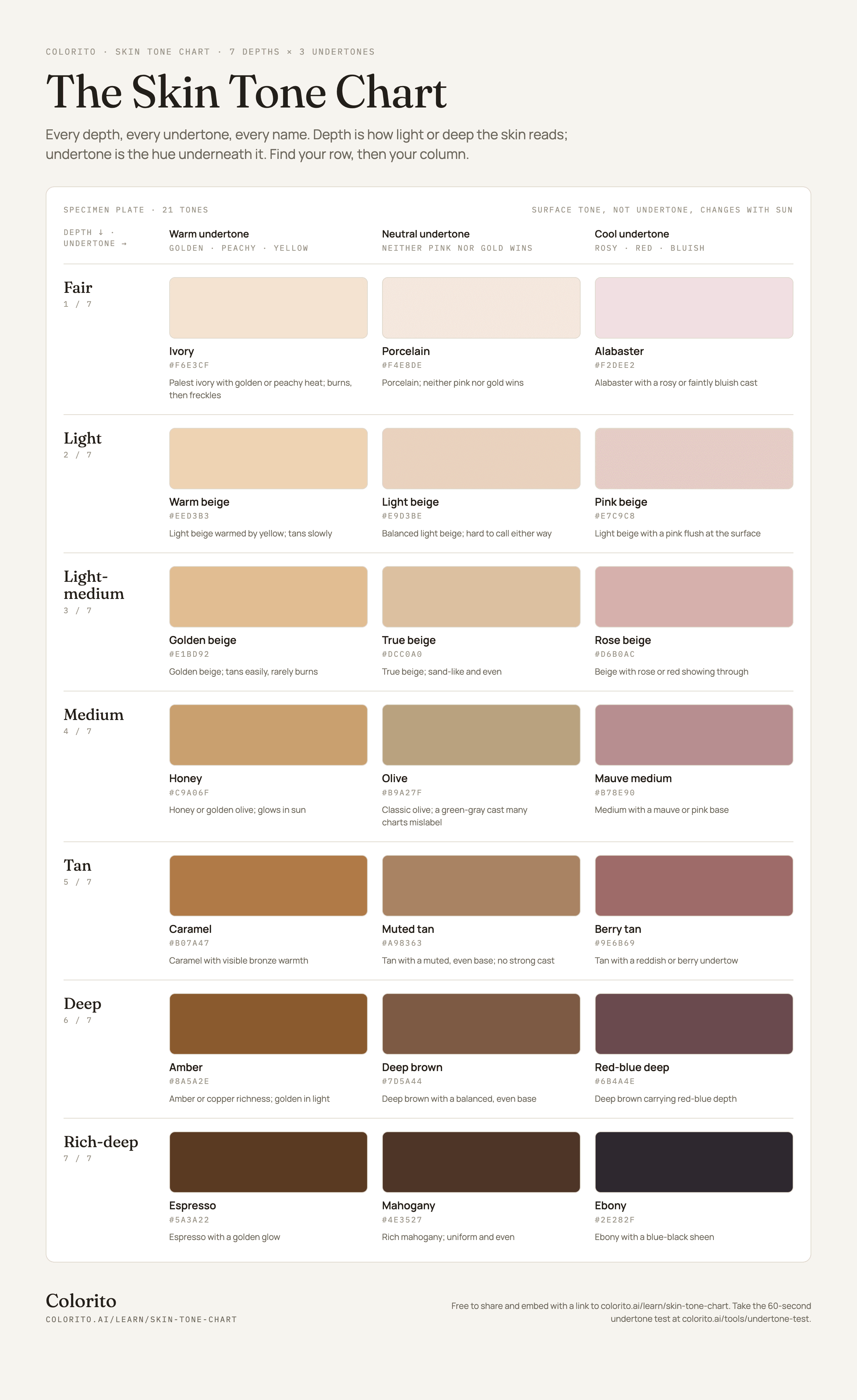
A skin tone chart maps two things: depth, meaning how light or deep your skin is, and undertone, meaning the warm, cool, or neutral cast beneath the surface. Most charts stop at depth. That is why they fail. The chart below covers both, decodes the names you see on labels, and shows how to find yours in sixty seconds.
Depth changes with the seasons. Undertone does not. A tan fades; the golden or rosy cast underneath stays exactly where it was. That single fact explains why two people who look the same shade in a photo can wear completely different colors well, and why the right chart reads in two directions at once.
This page is a reference, not a quiz. Read it to place yourself on the chart. Then, when you want the full answer, take the color analysis at the end. It does the precision work for you.
Embed this chart
Free to share and embed under CC BY 4.0 with a visible link back to this page — the snippet below includes it. Please don't alter the values. Full terms.
HTML
<a href="https://colorito.ai/learn/skin-tone-chart"><img src="https://colorito.ai/skin-tone-chart.png" alt="Skin tone chart: seven depth levels from fair to rich-deep, each shown with a warm, neutral, and cool undertone swatch, named and labeled with its hex value" width="2400" height="3920" style="max-width:100%;height:auto"></a>
<p>Chart by <a href="https://colorito.ai/learn/skin-tone-chart">Colorito</a></p>Surface Tone vs. Undertone: The Distinction Most Charts Miss
Surface tone is what a camera sees: the visible lightness or depth of your skin, driven by melanin and modified by sun, season, and circulation. It is the axis most charts use, and it is the less important one for choosing colors.
Undertone is the hue beneath the surface. Warm undertones lean golden, peachy, or yellow. Cool undertones lean pink, red, or bluish. Neutral sits between, with neither cast dominating. Undertone is fixed for life, which makes it the reliable half of the chart.
The two are independent. Fair skin can be warm; deep skin can be cool. Olive skin is the classic proof: a light-to-medium surface with a greenish, often cool-neutral undertone that turns supposedly universal shades ashy. When a color looks wrong on you despite matching your depth, undertone is almost always the culprit.
The Skin Tone Chart
Find your depth in the left column, then read across to the undertone that sounds like your skin. The pairing, such as medium-warm or deep-cool, is your working skin tone. Two coordinates, not one.
Depth names vary by brand, but seven levels cover the human range with enough resolution to be useful. Undertone descriptors below describe the cast you would notice in bare skin, in daylight, with no makeup.
| Depth | Warm undertone | Neutral undertone | Cool undertone |
|---|---|---|---|
| Fair | Palest ivory with golden or peachy heat; burns, then freckles | Porcelain; neither pink nor gold wins | Alabaster with a rosy or faintly bluish cast |
| Light | Light beige warmed by yellow; tans slowly | Balanced light beige; hard to call either way | Light beige with a pink flush at the surface |
| Light-medium | Golden beige; tans easily, rarely burns | True beige; sand-like and even | Beige with rose or red showing through |
| Medium | Honey or golden olive; glows in sun | Classic olive; a green-gray cast many charts mislabel | Medium with a mauve or pink base |
| Tan | Caramel with visible bronze warmth | Tan with a muted, even base; no strong cast | Tan with a reddish or berry undertow |
| Deep | Amber or copper richness; golden in light | Deep brown with a balanced, even base | Deep brown carrying red-blue depth |
| Rich-deep | Espresso with a golden glow | Rich mahogany; uniform and even | Ebony with a blue-black sheen |
Skin Tone Names, Decoded
Beauty and fashion labels use a poetic vocabulary that maps loosely onto the chart above. Here is what the common names actually mean, so you can translate any brand's shade list back into depth and undertone.
- —Ivory: fair depth with warm or neutral undertone; a soft, creamy pale rather than a pink one.
- —Porcelain: fair depth, neutral-to-cool; the palest shades most brands make.
- —Alabaster: fair and cool; pink or bluish cast, burns quickly.
- —Beige: light to light-medium, usually neutral; the workhorse of foundation walls.
- —Sand: light-medium and neutral-warm; even, slightly golden.
- —Olive: light to tan depth with a green-gray cast; usually neutral or cool-neutral, despite decades of being labeled warm.
- —Golden: any depth with a clearly warm, yellow-based undertone.
- —Honey: medium depth, warm; deeper than golden beige, lighter than caramel.
- —Caramel: tan depth, warm; rich and bronzed.
- —Bronze: tan to deep, warm; strong golden-red glow.
- —Espresso: rich-deep, typically warm; deep brown with golden warmth.
- —Mahogany: deep to rich-deep with red undertones; the cool-leaning counterpart to espresso.
- —Ebony: the deepest level, often cool; carries a blue-black sheen.
The 60-Second Undertone Test
You do not need equipment. You need daylight, a window, and three quick checks. Take the majority verdict.
First, veins. Look at the inside of your wrist. Green-looking veins suggest warm undertones; blue or purple suggest cool; a mix of both, or veins that match your skin too closely to call, suggest neutral.
Second, jewelry. Hold gold and silver against your bare forearm. Warm undertones make gold look inevitable and silver look stark. Cool undertones do the reverse. If both flatter you equally, you are neutral, and you have a genuine advantage.
Third, sun. Skin that tans easily and rarely burns usually runs warm. Skin that burns first, tans reluctantly, or flushes pink usually runs cool. This check is the least reliable at deeper depths, where burning is less visible, so weight the first two more heavily if they disagree.
From Skin Tone to Color Season
The chart tells you what your skin is. Seasonal color analysis tells you what to do about it. The 12-season system starts from your undertone, then adds two more dimensions: value, whether your overall coloring is light or dark, and chroma, whether it is clear or muted. Skin, hair, and eyes are read together.
Warm undertones point toward the Spring and Autumn families: Light, Warm, and Bright Spring; Soft, Warm, and Deep Autumn. Cool undertones point toward Summer and Winter: Light, Cool, and Soft Summer; Bright, Cool, and Deep Winter. (Warm Spring, Cool Summer, Warm Autumn, and Cool Winter are also called True Spring, True Summer, True Autumn, and True Winter.) Neutral undertones land in the border seasons, such as Soft Summer or Soft Autumn, where the palettes are muted and forgiving.
This is why the chart alone cannot finish the job. Two medium-warm people can be a Warm Autumn and a Bright Spring, and their best colors barely overlap. The chart gets you to the right neighborhood. The season gets you to the right address.
Why Foundation Charts and Clothing Color Charts Differ
A foundation chart solves a matching problem. Its goal is to disappear: find the shade closest to your surface tone at its current depth, adjusted for undertone so it does not oxidize orange or go gray. When your depth shifts in summer, your foundation shade should shift with it.
A clothing color chart solves a harmony problem. Its goal is contrast and resonance, not camouflage: colors that sit near your skin and make it look clearer, brighter, more even. Those colors key off your undertone and your overall contrast level, which do not change with a tan.
So use each chart for its job. Re-match foundation twice a year. Learn your clothing palette once, and keep it for life. People who apply foundation logic to their wardrobe end up dressed in their own skin tone, which flattens everyone.
You have the chart. Now get the verdict.
Colorito's color analysis reads your undertone, depth, and contrast, then hands you your season and the exact colors to wear. $9, one minute.
Find your season — $9Keep exploring
Skin undertone test
Five at-home checks, warm to olive
The full guide to color analysis
Undertone, depth, contrast — how the verdict works.
Seasonal color analysis, explained
Where your undertone lands among the twelve seasons.
What season am I?
Three questions that narrow twelve seasons to one
What sunglasses fit my face?
Your undertone decides the frame color too
Frequently asked questions
What are the main skin tone categories?
Most systems use four to seven depth levels: fair, light, light-medium, medium, tan, deep, and rich-deep. Each level is then split by undertone into warm, neutral, and cool. That grid of depth times undertone is the full chart. Depth alone is not a skin tone category; fair-warm and fair-cool are meaningfully different skins that suit different colors.
How do I know if I am warm, cool, or neutral?
Run three checks in daylight and take the majority. Green-looking wrist veins, gold jewelry flattering you, and easy tanning point to warm. Blue-purple veins, silver flattering you, and burning before tanning point to cool. Mixed or unclear results on all three point to neutral, which means both gold and silver, and most palettes, can work on you.
Is olive skin warm or cool?
Usually neither, cleanly. Olive skin carries a green-gray cast that most analysts read as neutral or cool-neutral, even though the surface can look golden. That is why classic warm shades like orange and camel often turn olive skin sallow, while muted, cooler colors sharpen it. If gold jewelry works but warm-toned foundation goes yellow on you, suspect olive.
Can my skin tone change over time?
Depth changes; undertone does not. Sun exposure, season, and age all move your surface tone lighter or darker, which is why foundation needs re-matching. The warm, cool, or neutral cast beneath is set by genetics and stays constant for life. Any chart result based on undertone, including your color season, holds year-round and decade after decade.
Which skin tone chart should I use for clothing colors?
One that includes undertone, then a seasonal palette built from it. Depth-only charts can tell you a shade matches your skin, which is precisely what you do not want in clothing. Your best clothing colors harmonize with your undertone and contrast level. The 12-season system is the most practical translation of the chart into a wearable palette.